
2009 - John Wiley et Sons Ltd.
ID: 6324202
E-book PDF (13,54 Mb)
Compatible solo con Adobe Acrobat Reader - software gratuito - (descubra cómo abrir los archivos)
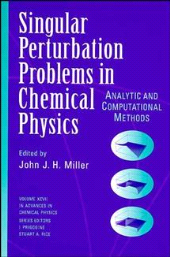
Single Perturbation Problems in Chemical Physics : Analytic and Computational Methods, Volume 97
373 p.
The Matching Method for Asymptotic Solutions in Chemical PhysicsProblems by A. M. Il'in, L. A. Kalyakin, and S. I.Maslennikov Singularly Perturbed Problems with Boundary and Interior Layers:Theory and Application by V. F. Butuzov and A. B. Vasilieva Numerical Methods for Singularly Perturbed Boundary Value ProblemsModeling Diffusion Processes by V. L. Kolmogorov and G. I.Shishkin An important addition to the Advances in Chemical Physics series,this volume makes available for the first time in English the workof leading Russian researchers in singular perturbation theory andits application. Since boundary layers were first introduced byPrandtl early in this century, rapid advances have been made in theanalytic and numerical investigation of these phenomena, andnowhere have these advances been more notable than in the Russianschool of singular perturbation theory. The three chapters in thisvolume treat various aspects of singular perturbations and theirnumerical solution, and represent some of the best work
done inthis area: * The first chapter, "The Matching Method for Asymptotic Solutionsin Chemical Physics Problems," is concerned with the analysis ofsome singular perturbation problems that arise in chemicalkinetics. In this chapter the matching method is applied to findasymptotic solutions to some dynamical systems of ordinarydifferential equations whose solutions have multiscale timedependence. * The second chapter, "Singularly Perturbed Problems with Boundaryand Interior Layers: Theory and Application," offers acomprehensive overview of the theory and application of asymptoticapproximations for many different kinds of problems in chemicalphysics governed by either ordinary or partial differentialequations with boundary and interior layers. * The third chapter, "Numerical Methods for Singularly PerturbedBoundary Value Problems Modeling Diffusion Processes," discussesthe numerical difficulties that arise in solving the problemsdescribed in the first two chapters, and proposes rigorous criteriafor determining
whether or not a numerical method is satisfactoryfor such problems. Methods satisfying these criteria are thenconstructed and applied to obtain numerical solutions to a range ofsample problems. Timely, authoritative, and invaluable to researchers in all areasof chemical physics, Singular Perturbation Problems in ChemicalPhysics is an essential resource. [Publisher's Text]
449662 characters.
-
Información
ISBN: 9780470142097
COLECCIÓN
MATERIAS
IVA excluido
PDF
E-book
E-book
Consulta las condiciones de uso